An Analysis of Big Data on Health: Critique is Not Optional

What follows is the material presented at the  ‘Vice and Virtue: the Rise of Self-Tracking Technologies and the Moralising of ‘Health’ Behaviours’ on the 10th-13th May 2016 Brocher Foundation, Switzerland (http://brocher.ch)
Website: http://www.brocher.ch/en/events/221/vice-and-virtue-the-rise-of-self-tracking-technologies-and-the-moralising-of-health-behaviours/
An Analysis of Big Data on Health_001

An Analysis of Big Data on Health (pdf file of slides)

The abstract for what is a WORK IN PROGRESS 

can be accessed here….

The ‘social’ has always been a commercial and scientific resource – now in the digital age the competition regarding claims to which disciplines have justified understandings of this domain have intensified. The social sciences need to defend their subject area in order to preserve it. An application of the netnographic approach (Kozinets, 2010), social network analysis, data mining and machine-learning tools to highlight the certainties and uncertainties of Big Data and the Health Industry in order to start the process of uncovering the social and cultural forces that they are appropriating. What follows is the application of the tools of Big Data analytics on those that conduct Big Data analytics. There are competing discourses surrounding ‘Big Data’ and Health. On the one hand business, marketing and advertising interests are promoting Big Data as information that no longer requires theory or the scientific methodologies of old. On the other are voices from the academy; digital humanities and computational social sciences that wish to benefit from the volumes of available data. It is these (and other) competing discourses that are the target of this research. This paper argues that those engaged in ‘data without theory’ are generating a relational social mechanism similar to that of self-fulfilling prophesies of Merton, the network effects of Coleman and the bandwagon effects of Granovetter (Donati, 2015:66) and leaving no room for critique. (Continue reading)
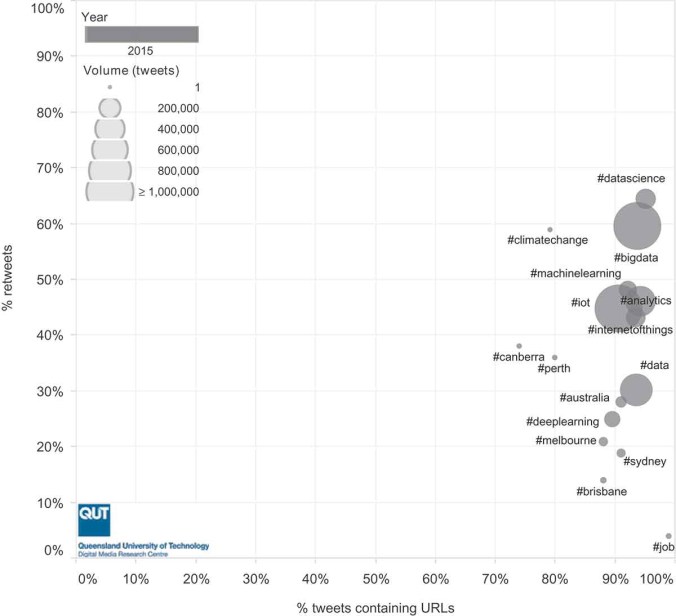
Towards a typology of hashtag publics: a large-scale comparative study of user engagement across trending topics

“what we have defined as keyword hashtags constitute a very different way of using hashtags – largely for emphasis rather than to institute an issue public –, and the uses and utility of such hashtags remain to be explored in greater detail still.”

“what we have defined as keyword hashtags constitute a very different way of using hashtags – largely for emphasis rather than to institute an issue public –, and the uses and utility of such hashtags remain to be explored in greater detail still.”

by Axel Bruns, Brenda Moon, Avijit Paul & Felix Münch (2016)

Twitter’s hashtag functionality is now used for a very wide variety of purposes, from covering crises and other breaking news events through gathering an instant community around shared media texts (such as sporting events and TV broadcasts) to signalling emotive states from amusement to despair. These divergent uses of the hashtag are increasingly recognised in the literature, with attention paid especially to the ability for hashtags to facilitate the creation of ad hoc or hashtag publics. A more comprehensive understanding of these different uses of hashtags has yet to be developed, however.
Previous research has explored the potential for a systematic analysis of the quantitative metrics that could be generated from processing a series of hashtag datasets. Such research found, for example, that crisis-related hashtags exhibited a significantly larger incidence of retweets and tweets containing URLs than hashtags relating to televised events, and on this basis hypothesised that the information-seeking and -sharing behaviours of Twitter users in such different contexts were substantially divergent.
This article updates such study and their methodology by examining the communicative metrics of a considerably larger and more diverse number of hashtag datasets, compiled over the past five years. This provides an opportunity both to confirm earlier findings, as well as to explore whether hashtag use practices may have shifted subsequently as Twitter’s userbase has developed further; it also enables the identification of further hashtag types beyond the “crisis” and “mainstream media event” types outlined to date. The article also explores the presence of such patterns beyond recognised hashtags, by incorporating an analysis of a number of keyword-based datasets.
This large-scale, comparative approach contributes towards the establishment of a more comprehensive typology of hashtags and their publics, and the metrics it describes will also be able to be used to classify new hashtags emerging in the future. In turn, this may enable researchers to develop systems for automatically distinguishing newly trending topics into a number of event types, which may be useful for example for the automatic detection of acute crises and other breaking news events.

http://www.tandfonline.com/eprint/pT4Cb5xWnmiv5QSEqNNn/full#.VyiBR1mQf_0

CONTACT
Axel Bruns – a.bruns@qut.edu.au
With contributing authors Jan Schmidt, Fabio Giglietto, Steven McDermott, Till Keyling, Xi Cui, Steff en Lemke, Isabella Peters, Athanasios Mazarakis, Yu-Chung Cheng, and Pailin Chen

Vice and Virtue: the Rise of Self-Tracking Technologies and the Moralising of ‘Health’ Behaviours

 
10th-13th May 2016
Brocher Foundation, Switzerland (http://brocher.ch)
Attendance is free but registration is essential as places are limited. Please email Becky Brown (rebecca.brown@abdn.ac.uk) if you would like to attend.
Provisional programme:
Becky Brown
Public Health Promotion and the Moralisation of ‘Lifestyle’ Behaviour
 
John Coggon
‘Coercive Healthism’ and Individual Choices to ‘Live Healthily’
Paul Crawshaw
Social marketing, inequality and governance failure in global public health
 
Luna Dolezal
Human Life as Digitized Data Assemblage: Health, Wealth and Biopower in Gary Shteyngart’s Super Sad True Love Story
Vikki Entwistle
Health professionals and the moralisation (or not) of ‘self-management’ among people with long-term health conditions
François Hudon
Social Justice, Freedom and Self-Tracking Technologies
Samia Hurst
TBC
Steven McDermott
An Analysis of Big Data on Health: Critique is Not Optional
Heather Morgan
Digital technologies + chronic health conditions = new modes for moralising?
Susan Oman
TBC
John Owens and Alan Cribb
Promoting health, promoting autonomy? Deliberation, action and freedom in an age of wearable technologies
 
Christopher Till
TBC

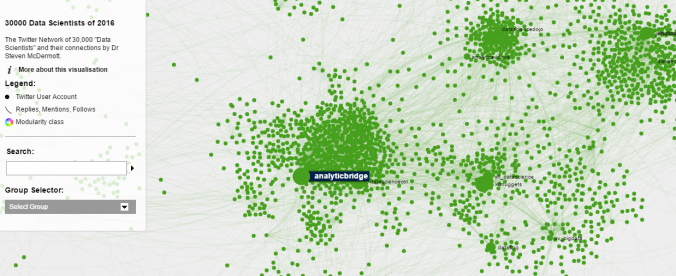
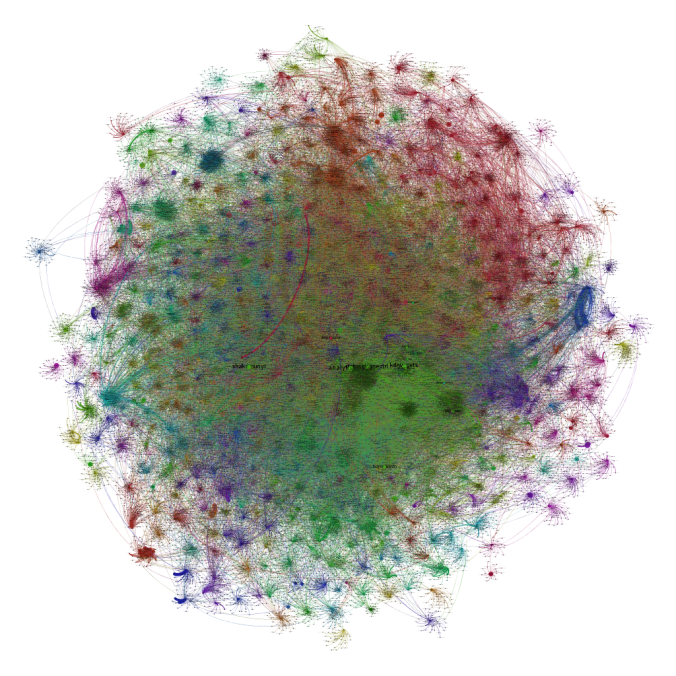
Data Scientists of 2016

A searchable and interactive network graph of Data Scientists archived in February 2016

The Twitter Network of 30,000 "Data Scientists" and their connections

The Twitter Network of 30,000 “Data Scientists” and their connections

The visualisation was created using Gephi after applying 3 steps on NodeXL. Step 1 – A Twitter search for the term ‘datascientist’ on 02/02/2016 that returned… Step 2 – 1,132 user accounts Step 3 – Input the 1,132 user accounts in to a Twitter User search that returned 30,000 user accounts. Export into Gephi with Modularity Class selected to differentiate groups and OpenOrd to set the graph.

You can search by name or select various groups that have been classed together according to modularity.

30000 Data Scientists 2016 pdf version

Data Scientist Twitter Network Visualisation 2016

@analyticsbridge Twitter Network Visualizationn 2016


The quest to find Data Scientists specifically related to Health has taken one small step forward.

For further information contact s.mcdermott@lcc.arts.ac.uk

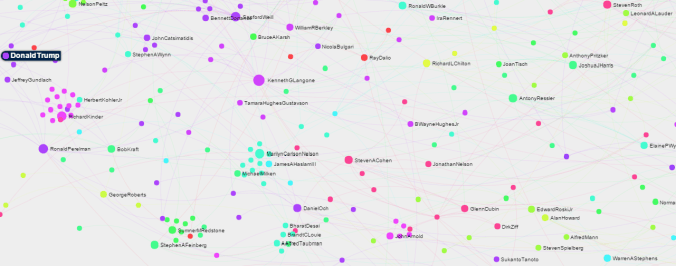
The Forbes Billionaire List and their Connections – 2015

The Forbes 2015’s Billionaires (2015). Forbes ranks more than 1,800 billionaires and these are their company, and affilations with Government Bodies etc – This list was then adapted by LittleSis http://littlesis.org/lists/846-the-world-s-billionaires-2015/members . I have then used it to construct a network which I’ve then visualised using Gephi.

Clicking on the image opens an interactive and searchable version.

imageof forbes2015

The Forbes Rich List and their Connections

It follows the same principle as those laid out here

Forbes magazine has been publishing the list of The World’s Most Powerful People since 2009. The number of people in the list is proportional to the global population with the ratio being one slot for every 100 million people on Earth. When the list started in 2009, there were 67 people on the list and the latest list from year 2014 had 72 people. According for Forbes, the list is calculated based on the person’s influence over lots of other people (e.g. Pope Francis, Wal-Mart CEO, Doug McMillon), financial resources controlled by the people (e.g. GDP, market capitalization, profits, assets, revenues and net worth), power in multiple spheres (e.g. Bill Gates), active use of power by the people (e.g. Vladimir Putin). While this list gives a snapshot of global ranking, it does not reveal information about past and present network connections and inter-linkages between people and organisations, the spread of power across the network, information about key entities who act as network intermediaries for power and which cluster of entities are most prominent in this global power structure. This is where we complement the Forbes data with LittleSis, which is a database of who-knows-who at the heights of business and government. LittleSis has information of the global rich and powerful such as past and present organizational affiliations (employment, directorships, memberships, alumni networks), donations (political contributions, grants), social connections (family ties, mentorships, friendships), professional connections (partnerships, supervisory relationships), services/contracts (legal representation, government contracts, lobbying services) etc.  http://www.datasciencecentral.com/profiles/blogs/the-alternative-list-of-global-power-elite

For further information regarding this interactive and searchable visualisation please contact s.mcdermott@lcc.arts.ac.uk or @soci