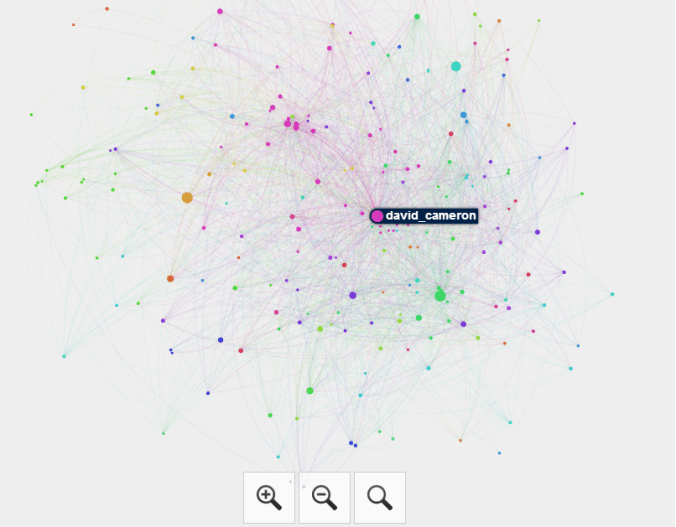
Interactive Map of UK MPs on Twitter August 2014
Interactive Map of UK MPs on Twitter August 2014
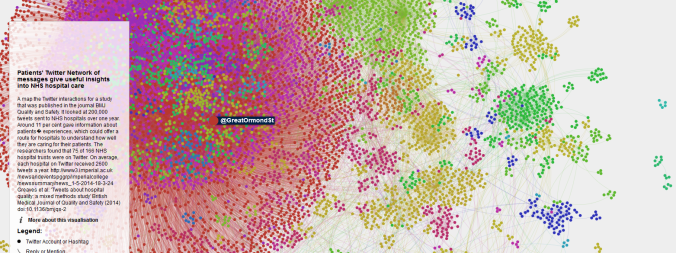
Patients’ Twitter Network of messages give useful insights into NHS hospital care
Dr Felix Greaves has very generously provided the Twitter data for this visualisation. The initial batch of data contained 149,000 nnodes (approx). I was then able to isolate a core of 12,000 Nodes (approx) using Pajek and then able to create the image using Gephi.
The study, published in the journal BMJ Quality and Safety, looked at 200,000 tweets sent to NHS hospitals over one year. Around 11 per cent gave information about patients’ experiences, which could offer a route for hospitals to understand how well they are caring for their patients.
The researchers found that 75 of 166 NHS hospital trusts were on Twitter. On average, each hospital on Twitter received 2600 tweets a year.
Reference: Greaves et al. ‘Tweets about hospital quality: a mixed methods study’ British Medical Journal of Quality and Safety (2014) doi:10.1136/bmjqs-2
This a video developed as part of the analysis of data that I gathered for a dry run of a larger project that I am conducting with colleagues at the Institute of Communications Studies, University of Leeds. This is the Leeds online website and blog network over six days. In late June 2011.
Each circle is a website or blog. The size of the circle indicates the centrality or ‘importance’ of the website in the exchange or flow of ideas and interests.
The lines between the circles are hyperlinks between the sites. The thicker the line, the stronger and more valued the link.
When a line turns red it means the link has been removed. When a line is green it means that a link has been created.
So if a site moves from the edge towards the centre it has gained in control of the flow of ideas and interests for that period.
As it stands it contains the top 200 sites and this is expected to change substantially in the final data collection period.
And here is a different version of the same data:
And finally from the same project the Twitter Accounts Related to Leeds on Saturday 18th of June 2011:
This is one snap shot of 35,000 (approx) twitter accounts related to Leeds, UK. Again it is part of a dry run for a project that I am working on with colleagues from the Institute of Communications Studies at the University of Leeds.
Each circle is one twitter account and the grey lines between them means that they are following, being followed, replied directly to or retweeted by the other.
The size of the circle indicates the betweenness centrality score for that twitter account.

McDermott, Steven Eunan (2013) Countering the social ignorance of ‘social’ network analysis and data mining with ethnography – a case study of the Singapore blogosphere. PhD thesis, University of Leeds.
McDermott SE Communications PhD 2013.pdf – Final eThesis (pdf)
Available under License Creative Commons Attribution-Noncommercial-Share Alike 2.0 UK: England & Wales.
Download (8Mb) | Preview
Abstract
This thesis questions on one level the assertion that the Internet is a force for democratisation in authoritarian regimes (Habermas, 2006), and at the same time another means for disseminating propaganda, fear and intimidation (Rodan, 1998). It overcomes the limitations of using automated data collection and analysis of blogs by supplementing these techniques with a prolonged period of participant observation and a detailed reading of the textual extracts in order to allow for meaning to emerge. It analyses the discourses and styles of discourse of the Singapore political blogosphere. Hurst (2006) and Lin and Sundaram et al., (2007) described the same blogosphere as isolated from the global blogosphere and clearly demarcated with no central topic. Countering the social ignorance of such automated data collection and analysis techniques, this study assigns meaning to data gathered from January 2009 to February 2010. This case study will help highlight the analytic framework, benefits and limitations of using social network analysis and an anthropological approach to networks. It has targeted blogs using hyperlink network analysis and measured ‘importance’ with ‘betweenness centrality’ (de Nooy & Mrvar et al., 2005) in order to demarcate the boundaries of the sample of blogs that are archived for semantic and discourse analysis. Beyond a brief introduction to betweenness centrality, and the merits or otherwise, of combining various ranking of blogs such as Google’s PageRank, Hits and Blogrank algorithms it avoids the algorithm fetishism within hyperlink data collection and linguistic analysis of corpus collected from blogs; allowing for culture, identity and agency. It assesses which of White’s (2009) three disciplines and relative valuation orders the Singapore blogosphere adheres. The contention raised here is that social network analysis, or rather those elements within it that are focused exclusively on algorithms, are in danger of co-option by states and multinational corporations (Wolfe, 2010:3) unless they acknowledge sociocultural forces. The tools of social network analysis and data mining are moved beyond mere description, while avoiding prescription – and at the same time advancing its contribution to substantive theoretical questions (Scott, 2010). Ensuring space for agency in a field dominated by sociograms, statistics and algorithms with theory that places persons lacking recognition at its centre is important to this thesis. Focusing only on the relational aspects of the interaction and in the individual persons linked (Wolfe, 2010: 3) creates a limited representation of the wider phenomena under study and a narrow awareness of the context in which these networks exist. A people governed by one political party since 1963 (The People’s Action Party) with the government of Singapore is the focus of this case study. This paper also highlights the use of various software technology; blogs, IssueCrawler, HTTrack, NetDraw, and Leximancer while using an ethnographic approach to counter the social ignorance of automated electronic software. The analysis of the Singaporean blogosphere from 2009 to 2010 provides a descriptive analysis of the argument that the non-democratic nature of Singapore society shapes the development of online public spheres.
DOWNLOAD ENTIRE eTHESIS 270pages (PDF)
Item Type: Thesis (PhD)
Academic Units: The University of Leeds > Faculty of Performance, Visual Arts and Communications (Leeds) > Institute of Communication Studies (Leeds)
Depositing User: Repository Administrator
Date Deposited: 13 Jun 2014 12:15
Last Modified: 13 Jun 2014 12:16
URI: http://etheses.whiterose.ac.uk/id/eprint/6341
And just for fun…
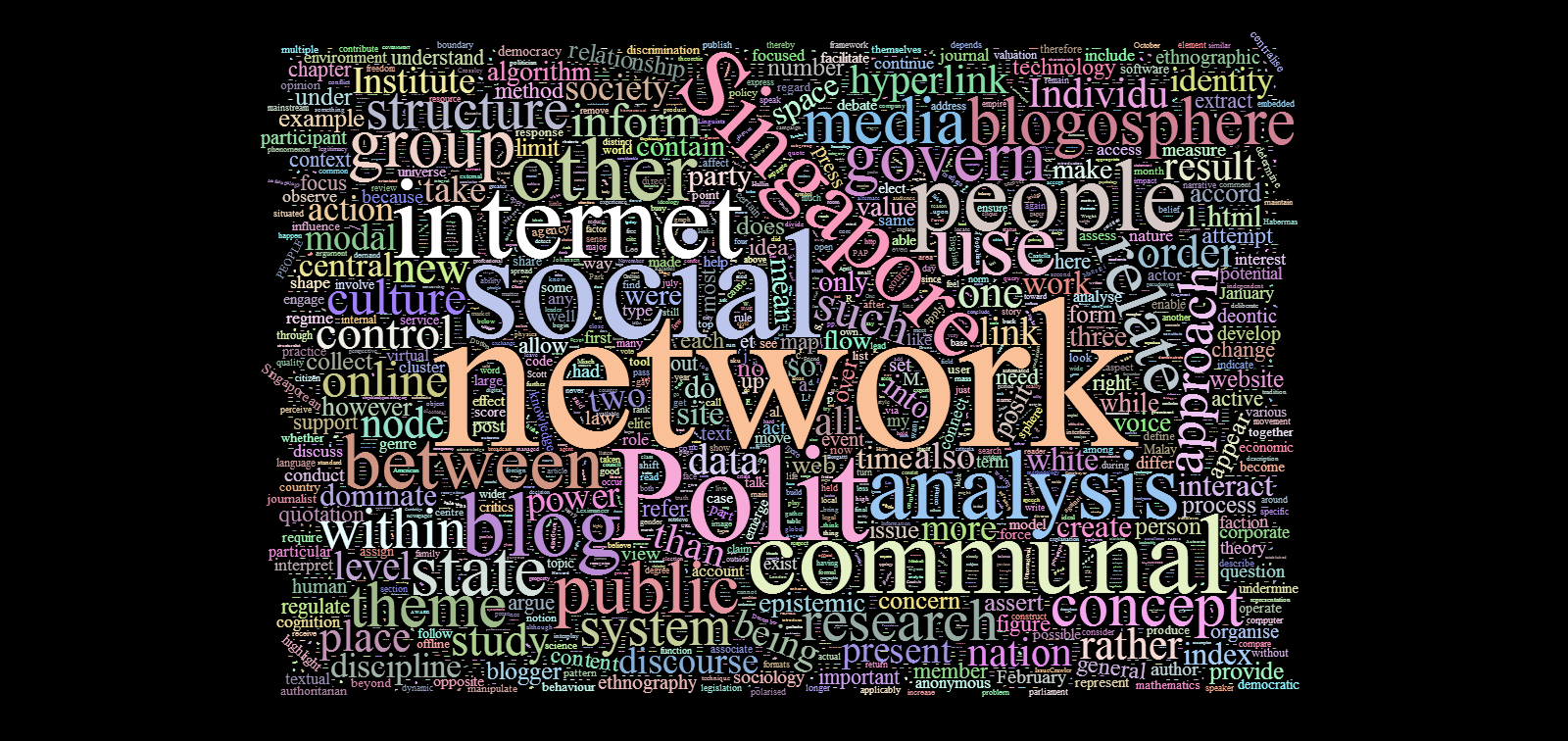
Countering the social ignorance of ‘social’ network analysis and data mining with ethnography wordle
 'SOCIAL' NETWORK ANALYSIS OF THE MEDIA ECOLOGY